

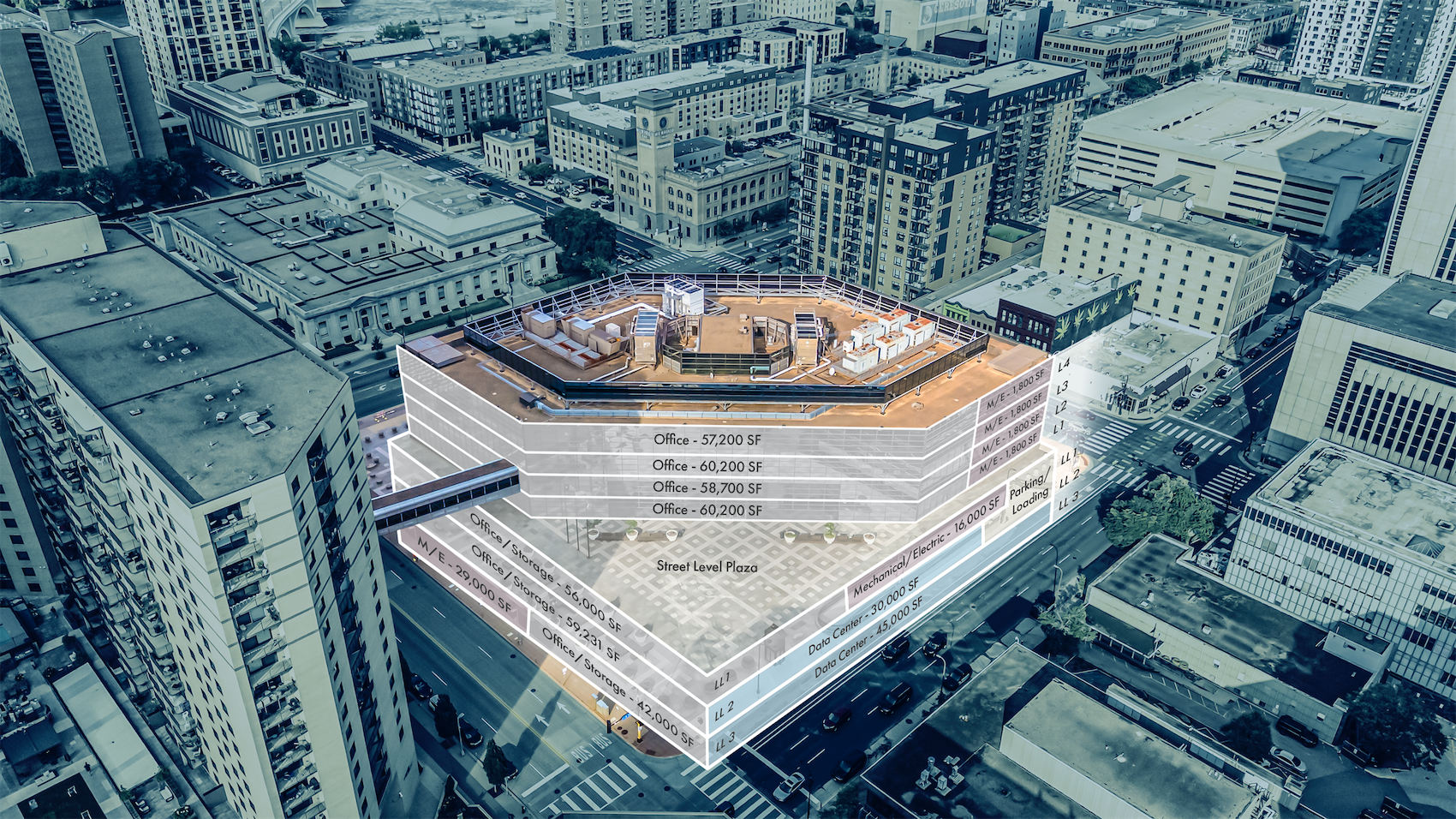
The low-slung, six-sided building at 255 Second Ave. S has been vacant for nearly six years. Wells Fargo moved the last of its employees out of the former Norwest Operations Center — an IT and office logistics hub — in March 2020, just as the COVID-19 pandemic set in.
It was a remarkable feat of timing for the banking giant and one more black eye for a business district saddled with millions upon millions of square feet of excess office space.
Sherman Associates bought the nearly 550,000 square-foot block in August 2022. A month later, the Minneapolis-based developer unveiled a $400 million vision for hundreds of housing units and a fair bit of mixed-use space across three towers, one of which would rise more than 25 stories.
That never happened. As interest rates surged and construction costs followed, Sherman shelved the proposal — first known as Harmonia, then Washington Yards — and pivoted to the sort of adaptive reuse project that developers find more feasible these days.
“There are not many cranes in the sky right now, and the ones that are up are often not for housing,” Sherman Associates president Chris Sherman said in an interview. “Almost all of our work right now is in existing spaces,” he added.
Sherman is no stranger to big renovation projects like the $65 million Riverside Plaza refresh it led a decade ago and the nearly $100 million, 216-unit Northstar Lofts office-to-housing conversion that wrapped up last year.
The repositioning of 255 Second Ave. S will be very different and probably more less noticeable to casual observers, even those who live and work nearby. The biggest changes at the site will happen underground, where a major electrical service upgrade and new generator room will support a modern data center that takes the place of Wells Fargo’s obsolete computing facility. Office or education users could move into the aboveground floors, which comprise only about 40% of the property’s roofed-in square footage, Sherman said.
The plan has all the necessary permits, according to a city spokesperson. Sherman Associates told the city in a detailed filing that it expects Xcel Energy to make the necessary electrical upgrades by the end of next year. If all goes well, the “first major phase” of the 75,000 square-foot data center buildout should be done in 2028, Sherman said.
Outfitting a cutting-edge data center is no small feat. Data center construction costs range from $10 million to $15 million per megawatt of power capacity, depending on the market, according to commercial real estate firm Cushman & Wakefield. One megawatt is equal to the electricity consumption of 500 to 1,000 average homes.
Xcel’s expanded service at 255 Second Ave. S can support up to 20 megawatts for the data center itself and another six megawatts in the office portion. Sherman declined to provide a budget estimate but said the final development cost “will be similar if not more significant than the prior iteration of the project.”
Wrapped up in that cost are big-ticket, heavily engineered items like the generators — six of them, with enough combined power to run the data center through a grid outage — plus oversized chillers to manage the incredible amount of heat generated by the data center’s server racks. Though they likely won’t be running the super-high-performance chips found in what NVIDIA CEO Jensen Huang calls “AI factories,” the server racks themselves are far more expensive on a pound-for-pound basis than your work laptop.
Rather than train large language models like ChatGPT, Sherman Associates said in its filing with the city that the data center would likely qualify as an edge computing or colocation facility that provides low-latency connectivity for a range of business or consumer applications. Such facilities are much smaller than AI-focused “hyperscale” data centers, which the filing said typically have upwards of 100 megawatts of power capacity and resemble large industrial plants.
Downtown already has at least one “colo” hub: Cologix’s 45,000 square-foot 511 Building near U.S. Bank Stadium. Speaking to Downtown Voices, Chris Sherman ticked off several other existing or in-development data centers in the area, including one used exclusively by the Federal Reserve Bank of Minneapolis and another in expansion mode at Sleep Number’s headquarters at 10th Street and Third Ave. S.
Sherman said that while a single user could materialize, the former Wells Fargo facility will probably serve multiple customers. Whatever shape the final configuration takes, he expects it to be a boon for downtown.
“There’s significant demand being driven by consumers and companies that are demanding fast access to data,” he said. “Proximity to well-located data centers is critical for driving the consumer experience that [the city] is looking for to attract residents and small and large businesses,” Sherman said.
The plan is for the expanded data center to be a good neighbor.
With adequate and reliable electrical service to the building, the generators will rarely run, and their position well below-ground means they’ll be effectively noiseless when they do. They’ll vent well above street level, according to Sherman Associates’ filing.
The servers, meanwhile, will generate enough heat to keep the building toasty during the winter. They could even be in a position to sell excess heat into the district hot-water loop that heats dozens of downtown buildings, Sherman Associates said in its filing.
Speaking to Downtown Voices, Chris Sherman said engineering the data center to feed heat back into the district loop would be challenging, but feasible, and “meet material sustainability objectives” for the facility while creating a valuable case study for other urban data centers looking to do the same.
“We are having very active conversations with [system operator] Cordia on that,” he said. “The hope is that, over the next two to three months, we can firm up whether we can facilitate a high-impact outcome.”
Finally, and perhaps most impactful from the perspective of city leaders and taxpayers, is the project’s long-term budget impact. Unlike the Harmonia proposal, Sherman said the office and data center project won’t require public subsidy to pencil out — and, when fully utilized, would cut downtown’s 7 million square-foot inventory of vacant commercial space by around 8%.
“Now is the time to lean into reoccupying our vacant space downtown,” Sherman said.


